Your LON Wire Is Worth More Than Your LON Devices: Two Real T1L Retrofits
If you have LonWorks and a BACnet retrofit quote that came back unaffordable, the wire is usually the problem — not the controllers. Here's how we reused existing LON trunks as T1L Ethernet on two live buildings.
The Quote That Kills the Project
The conversation goes the same way almost every time.
A building owner has LonWorks. It works — mostly. But the controllers are getting hard to source, the graphics are dated, and nobody wants to be the person still running an end-of-life protocol in five years. So they ask for a number to move to BACnet.
The number comes back, and it’s not the controllers that blew it up. It’s the wire. New BACnet MS/TP homeruns or Cat 5/6 to every mechanical room means ceilings, conduit, fire-stopping, after-hours access, tenant disruption, and an electrical sub. On a lot of buildings the communication infrastructure is a bigger line item than the controls themselves.
So the project dies, and the building runs LON for another five years.
There’s a third option that a lot of owners haven’t been shown: keep the wire, change the physical layer. We’ve now done it on two occupied buildings. This article is what actually happened on both, including the part that will bite you if you’re not careful.
What Is T1L, and Why Does It Matter for a LON Building?
10BASE-T1L — usually just called T1L — is an IEEE standard (802.3cg, ratified November 2019) for running Ethernet over a single twisted pair. It is not a new protocol. It’s plain Ethernet, riding on different copper than you’re used to.
That distinction is the whole ballgame. Because T1L is an Ethernet physical layer, everything above it is normal IP: BACnet/IP, standard IT tooling, certificate-based encryption, BACnet Secure Connect. Your controllers become IP-addressable devices on a real network, not tokens on a fieldbus.
And because the standard defines characteristics for the cable rather than specifying a cable, existing twisted-pair building wire frequently qualifies.
Here’s the comparison that makes the case, drawn from Honeywell’s T1L technical resource guide:
| LonWorks FTT-10 | BACnet MS/TP | Cat 5/6 Ethernet | T1L Ethernet | |
|---|---|---|---|---|
| Total wire length | 500 m | 1200 m | 100 m | 300 m recommended, 1000 m max |
| Typical speed | 78 Kb/s | 32 Kb/s | 10 Mb/s – 1 Gb/s | 10 Mb/s |
| Supports IT standard protocols | No | No | Yes | Yes |
| Supports encryption | No | No | Yes | Yes |
| Proprietary | Yes | No | No | No |
| Relative cost | $ | $ | $$ | $ |
Read the LON column against the T1L column. You are going from 78 Kb/s to 10 Mb/s — roughly 128 times the bandwidth — on wire that is already in the building, with encryption and IT-standard protocols you couldn’t have before.
That’s the pitch. Now here’s how it actually went.
Case One: Four LON Trunks, Zero New Communication Wire
We inherited a building running four distinct long LON trunks, each carrying roughly 10 to 20 devices. Every trunk was a proper homerun back to the main JACE panel. Field devices were Honeywell Spyder Sylk Enhanced controllers on LON, aggregated through an Echelon LPR-10 LonWorks router in the main panel.
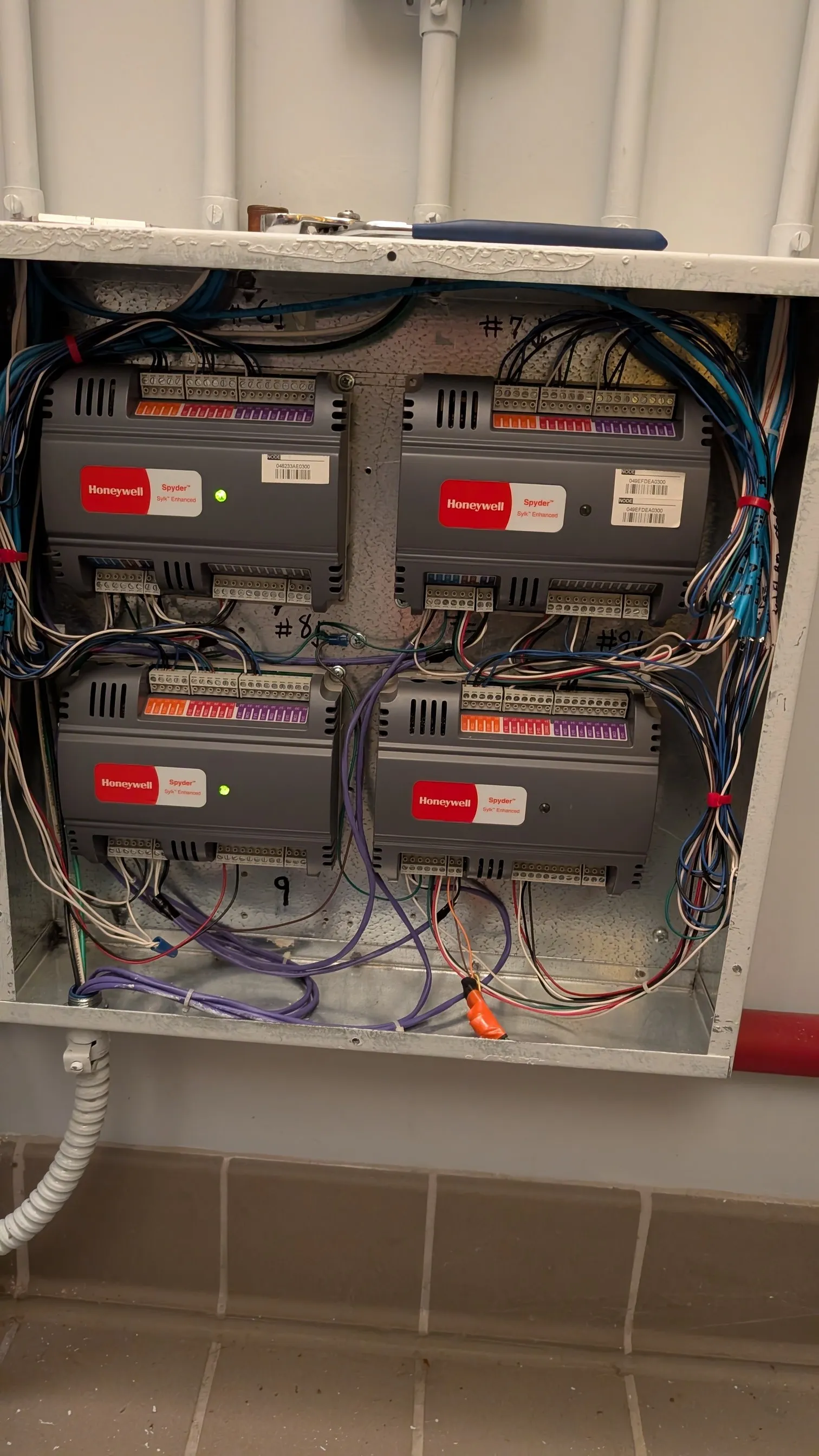
Before: four Spyder controllers on a LON trunk, serving AHUs 6 through 9.
The owner’s goal was to get off LON. The obstacle was the assumption that getting off LON meant pulling four new trunks’ worth of communication cable through an occupied building.
It didn’t. Here’s what we actually changed:
What we kept: every foot of existing trunk wire, and every homerun path back to the JACE panel.
What we removed: the LON field devices, and the Echelon LON router in the main panel.
What we added: T1L-capable controllers in the same enclosures, and a managed single-pair Ethernet switch in the main panel to land the four trunks.
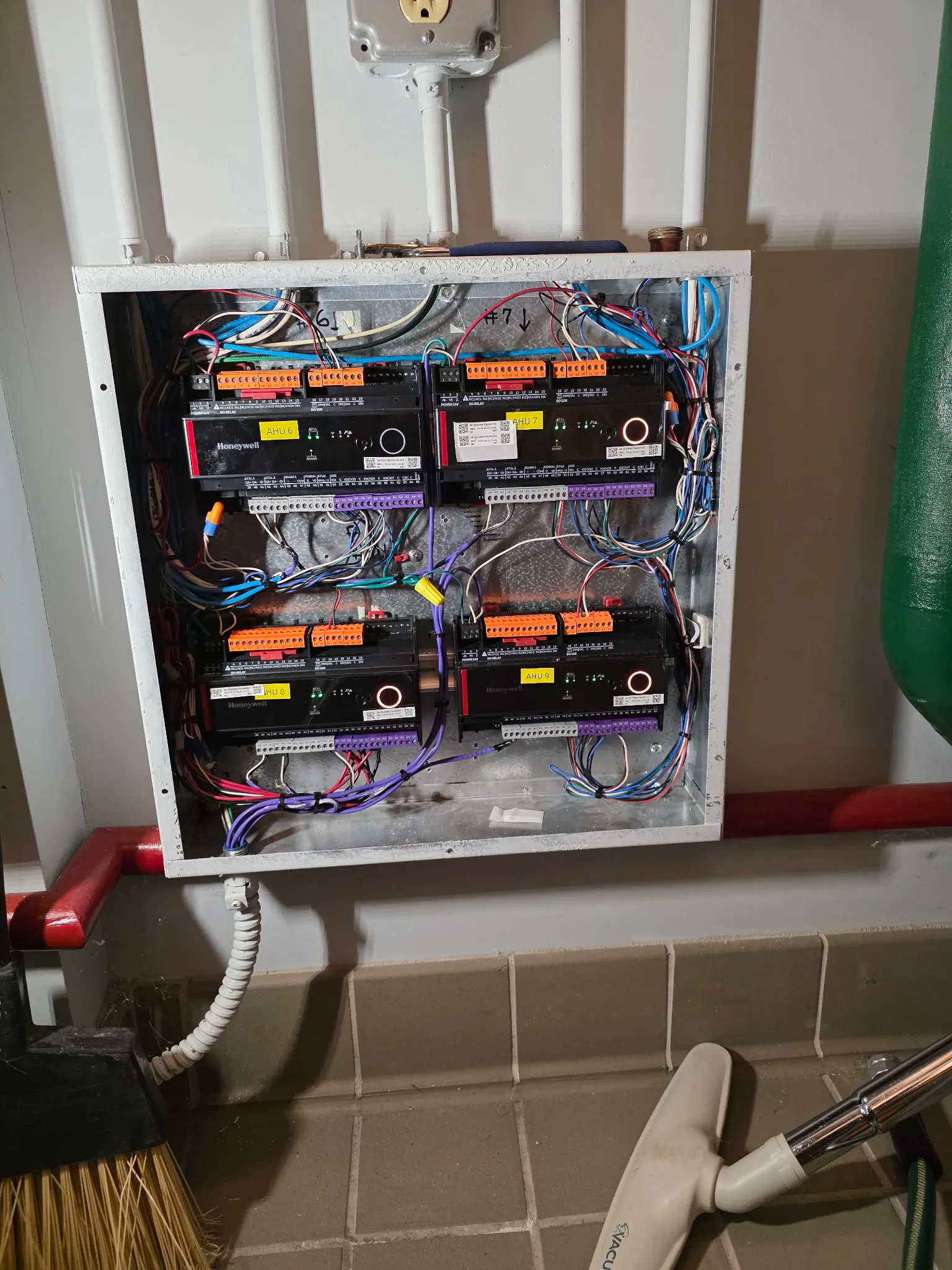
After: T1L-capable controllers in the same enclosure, on the same wire, now speaking BACnet/IP.
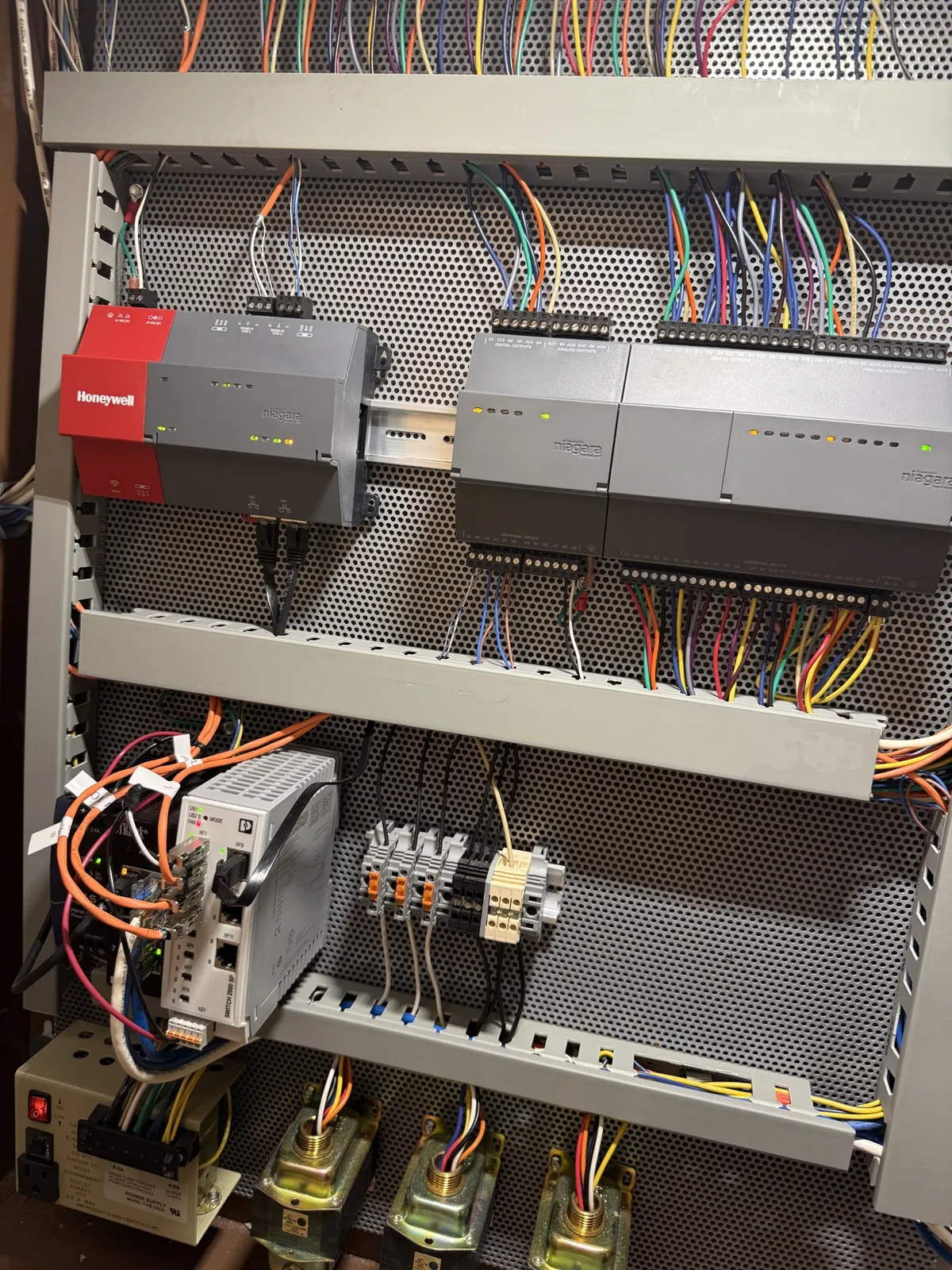
The main panel tells the story even better. In the before photo, a Honeywell WEB-600 JACE, Niagara I/O modules, a small unmanaged network switch, and the Echelon LPR-10 handling the LON trunks.
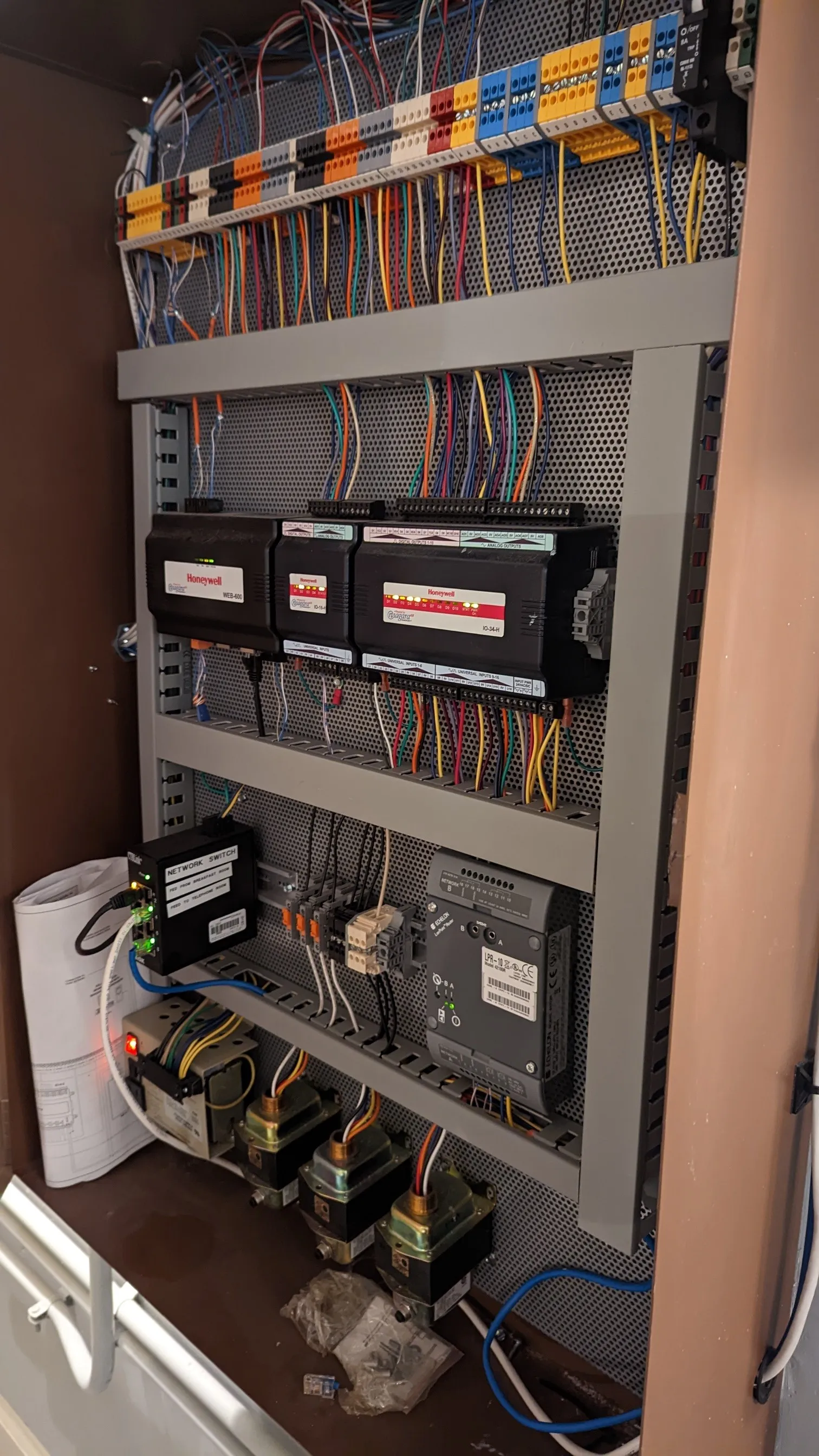
Before: the WEB-600 and the Echelon LON router that terminated the trunks.
In the after photo, a current Niagara JACE, updated I/O, and a Phoenix Contact managed SPE switch where the LON router used to sit. The four trunks land on the switch instead of the router. Same conduit, same wire, same terminations at the far end.
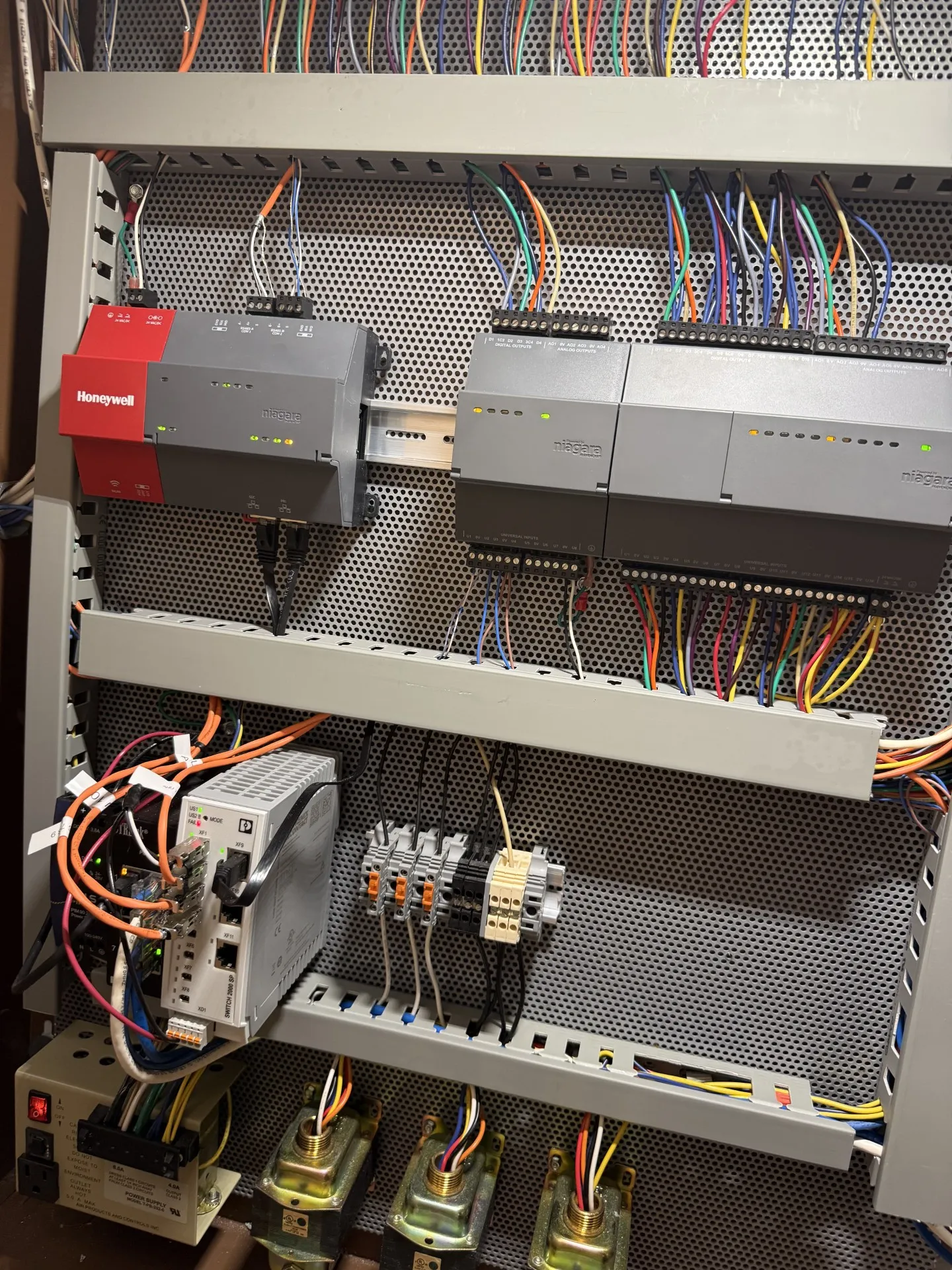
After: a managed SPE switch replaces the LON router. The trunks never moved.
The LON router coming out and the SPE switch going in is the single clearest picture of what T1L does. The building’s communication infrastructure didn’t change. Its capability did.
Just as importantly, the owner now gets a managed switch in that panel: port-level visibility, link status per trunk, and a diagnostic story that LON never offered. When a trunk has a problem, you can see which one and where, from the network side, instead of walking it with a meter.
Case Two: Keeping LON and T1L Alive on the Same Wire, One Segment at a Time
The second building is the one that changes how you sell this.
Roughly 30 to 34 existing VAV boxes on a LON trunk. Occupied space. No appetite for a shutdown, and no budget to do the whole trunk in one shot.
The constraint that makes phasing hard is obvious once you say it out loud: you can’t run LON and Ethernet on the same conductors at the same time. So how do you convert 34 boxes without a weekend where nobody has heat?
The answer is to work backwards from the end of the line.
Step one: find the true end of the trunk. Not the last box on the drawing — the actual electrical end of the daisy chain. This matters more than anything else in the sequence, and we’ll come back to it.
Step two: pull one new homerun to that last controller. This is the only significant new wire in the project. One run, to the far end of the trunk.
Step three: replace backwards, harvesting wire as you go. Convert the last controller to T1L on the new homerun. Now the segment of original LON wire between the last box and the second-to-last box is free. Reuse it. Convert the second-to-last box, and it rides that liberated segment back to the box you just did. Repeat, walking toward the JACE.
The result is that the trunk is always in two halves: the far end is live on T1L and BACnet, and the near end is still live on LON. Both are up. Both are controlling. Occupants never know.
You can stop at any point. Convert eight boxes this quarter, twelve next quarter, the rest next fiscal year. The building stays operational the entire time and there is never a “big bang” cutover to schedule, staff, and pray over. For an owner who has been told this is an all-or-nothing capital project, that flexibility is often worth more than the wire savings.
What Will Bite You: T-Taps and Sloppy Original Installs
Here is the thing that will wreck the phased approach if you don’t check for it first.
The whole method depends on the existing trunk being a genuine daisy chain — device to device to device, in a line. LON tolerates topologies that Ethernet does not. FTT-10 free topology was permissive by design: T-taps, stars, spurs off a junction box, a branch someone added in 2009 to pick up two boxes on the other side of a corridor. It all worked well enough on LON, so nobody documented it.
T1L is point-to-point, full duplex Ethernet. It does not tolerate a T-tap. The instant you convert a segment that turns out to have a hidden spur, you don’t get a degraded link — you get a link that doesn’t come up, and you’re troubleshooting in a ceiling on someone else’s schedule.
So before you commit to a phased plan:
- Physically trace the trunk. Don’t trust the as-builts. On a building old enough to have LON, the as-builts are a starting hypothesis, not a record.
- Find every junction box on the run. Spurs hide in them. Open them.
- Confirm the electrical end of the line, which is where your one new homerun is going. Getting this wrong means pulling that homerun twice.
- Check conductor count and quality per segment. You need a usable twisted pair per hop. Existing shield and drain practices matter here too.
- Watch your hop distances. T1L’s recommended device-to-device distance is 300 m, with 1000 m as the standard maximum. LON’s 500 m total trunk length means most existing runs are comfortably inside that — but verify the long ones rather than assuming.
Budget survey time for this. It is a fraction of the cost of the wire you’re avoiding, and it’s the difference between a clean phased conversion and an unpleasant surprise on the third segment.
When This Is the Right Answer — and When It Isn’t
T1L over reclaimed LON wire is a strong fit when:
- You have existing LON (or MS/TP) trunks with usable twisted pair and intact homeruns
- New communication pathways are expensive, disruptive, or effectively impossible in occupied space
- The owner wants IP addressability, encryption, and IT-standard tooling at the edge
- The capital has to be spread across multiple budget years
It’s the wrong answer when:
- The building already has structured cabling and pathway to the mechanical spaces, and Cat 6 is genuinely cheap to extend
- The existing trunk topology is a mess of undocumented spurs and the survey cost approaches the rewire cost
- The scope is a small service extension where BACnet MS/TP is entirely adequate and nobody needs IP at the box
T1L isn’t a universal replacement, and anyone selling it that way is overselling. What it is, specifically, is a way to make a modernization project pencil out on a building where the wire — not the controls — was the thing standing in the way.
The Part Owners Care About
Strip out the protocol detail and the argument is short:
The twisted pair in your walls is an asset. Most retrofit proposals treat it as scrap and price in its replacement. On both of these buildings, that wire carried the project instead of sinking it — and the owner ended up with a modern IP network to the edge, encryption, a managed switch with real diagnostics, and a device population that will be supportable for the next fifteen years.
One building did it all at once with zero new communication homeruns. The other is doing it a segment at a time, on its own schedule, with the old system and the new system running side by side on the same trunk.
Nimbus Stratus Energy Solutions provides building automation engineering, controls integration, and facility management services across the Mid-Atlantic region. If you have LonWorks and a retrofit number that didn’t work, we’re happy to walk your trunks and tell you honestly whether this approach fits your building. Get in touch.